- Star Trek: The Next Generation S6E9 “The Quality of Life”
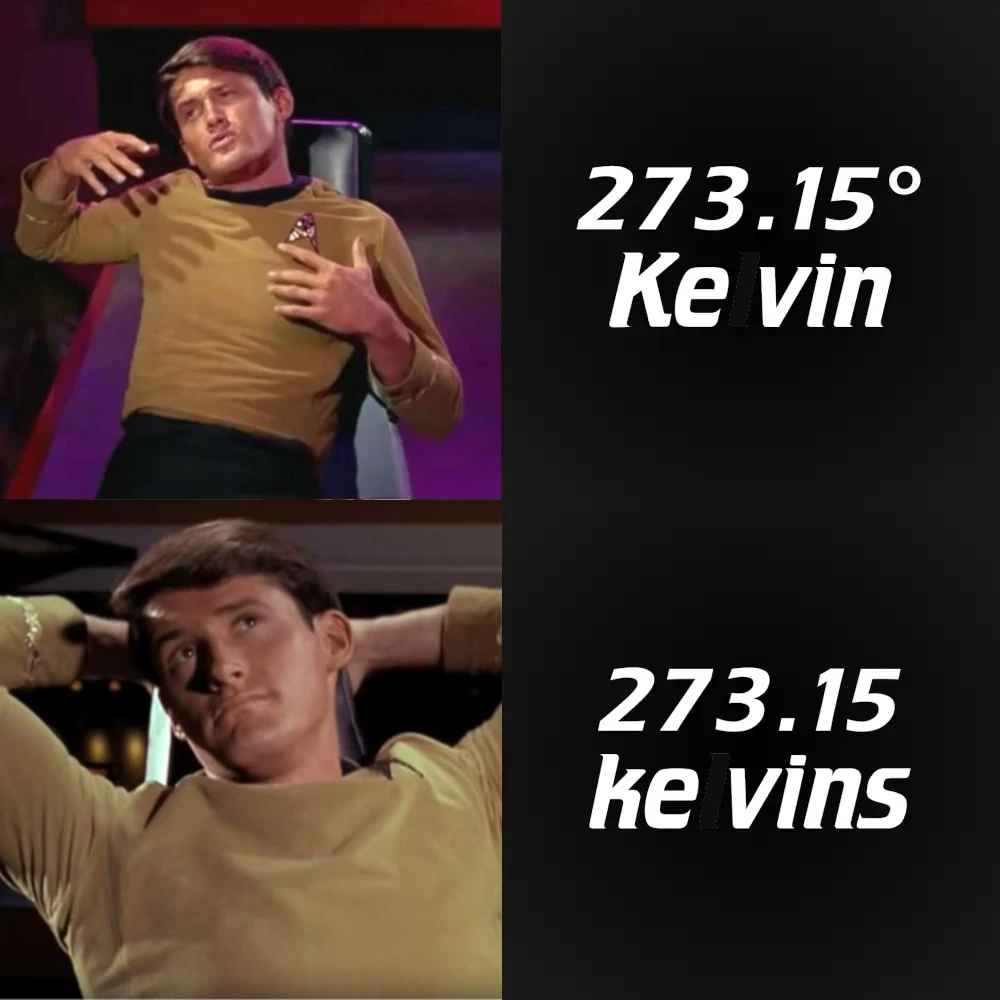
- https://knowyourmeme.com/memes/drakeposting
- https://memory-alpha.fandom.com/wiki/Kelvin
- https://en.wikipedia.org/wiki/Kelvin
According to SI convention, the kelvin is never referred to nor written as a degree. The word “kelvin” is not capitalized when used as a unit. It may be in plural form as appropriate (for example, “it is 283 kelvins outside”, as for “it is 50 degrees Fahrenheit” and “10 degrees Celsius”).[5][63][64][65] The unit’s symbol K is a capital letter,[39] per the SI convention to capitalize symbols of units derived from the name of a person.[66] It is common convention to capitalize Kelvin when referring to Lord Kelvin[5] or the Kelvin scale.[67]
What’s really annoying is that I can never find a way to convert centigrade to Celsius.
went right over my head until I googled it
This must be the Kelvin timeline I’ve heard so much about.
The SI convention can jump in a lake.
Kis too easy to confuse with the “kilo” suffixk, and the Kelvin was just a rebrand of the Celsius scale, which uses degrees, a convention so firmly intertwined with temperature measurements that in most contexts if you just say something is “X degrees” people will just assume are referring to degrees on a temperature scale (Fahrenheit or Celsius depending on where you live). Calling them degrees only increases the clarity of what you’re talking about in both written and spoken contexts; I’ve never encountered a downside other than dorks protesting that that’s not how it’s supposed to go. °K gang for life.I was taught as degrees Kelvin in middle school, (as well as degrees Rankini). Only in high school it was changed. Not sure if it was a change in standard or a correction in teaching.
According to Wikipedia it was officially changed from “degrees Kelvin” to “kelvins” in 1967, so it’s possible you were seeing the change ripple out as they were made. I wonder how long it takes for decisions like that to get from a decision announcement from the CGPM to an update in textbooks that students use. Probably varies by income level.
I’m sure the changes must be ratified at country level, which adds another significant layer of delay.
dorks
Some of us use the Kelvin scale on a nearly daily basis in our jobs that primarily focus on sweating the small details.
jobs that primarily focus on sweating the small details
Anyone with a job like that automatically qualifies as a “dork (complimentary)”
I use the term with affection, I think it’s that understanding of the importance of minutia to the shared understanding of complex topics that makes people engage on things like “K vs °K” in a serious way, and I think it’s a conversation worth having. I don’t use kelvins every day and I don’t really think I’m an expert, I think despite my last little joke I could be convinced that saying “degrees kelvin” does more to confuse than it does to clarify: I think there are good reasons to adhere to conventions in certain contexts, especially scientific ones, so I think the upset about “degrees kelvin” comes from a sincere place, I just haven’t seen any evidence to suggest that breaking the convention in this case causes any real confusion, and at least personally, using
°Khelps me distinguish kelvins from other uses ofkorKsuffixes or constants. So I guess it would be more accurate to say “°K gang for now given my understanding of the current body of evidence”, but I wanted to be snappy.I understand you’re not coming from a place of malice. But consider that not understanding why something is important is not a great reason to consider it unimportant if, nearly universally, experts consider it important.
I don’t think it’s unimportant. I think clarity and disambiguation in communication are more important than strict adherence to a convention, and as far as I can tell
°Kwas folded intoKbecause the temperature interval°Kis identical to the thermodynamic temperatureKand the CGPM pickedKbecause it more correctly conforms to the SI convention of single-letter unit designations. I get why they combined them, but considering that°Kis (or was) exactly equal toKI prefer to use it to typographically distinguish it from other k-types in my writing, especially if I’m writing equations by hand. I’ve been reading up on the CGPM proceedings around defining theKand I think there are good pedagogical reasons not to use°Kwhen introducing the concept of thermodynamic temperature to students because it isn’t a degree on a scale like Celsius, it’s a plain old base unit just like any other. It may be that I’m just old enough to have been indoctrinated into the°Kschool of thought and now it’s ingrained but in any case the visual distinction helps me and, since it is identical toKI don’t think it introduces any new confusion. I probably wouldn’t use it if I were teaching physics in high school but for my own use?°Kall day.
“IIIIIIIIIIIIIIIII’LL TAKE YOU HOOOOOOEEEEEM AAAAAAAAAAAGAAAAAAAAAAAAAAAAAAAAAAAIN, KATHLEEN!”
I just like it when Data says “kilopascals.”
Is there something special about his pronunciation or something?
He says, “ki-lo-pas-i-cals.”
Yeah. Its just like that.
6 degrees of Melvin.
Worf’s attention intensifies
You can never have enough Calvins.
And the only proper thermostat scale is kT in eV…