

You must log in or # to comment.
deleted by creator
Recent studies have it at closer to 92% ‘junk’ DNA, and 8% actively coding.
Also, a lot of non-coding DNA does actually serve other useful functions, it just doesn’t actively code.
It could play a role in epigenetics, ie the regulation of what active coding sequences are active and when, it could be telomeres that prevent DNA strands from unravelling at the ends, it could be binding and scaffold sites that assist in the structural stability and integrity of the chromosome.
DNA can be functional, without being active-coding.
Only regions that are both non coding and also totally non functional are truly ‘junk’, but we keep consistently finding more ways that ‘non functional’ regions are actually functional.
deleted by creator
I dunno whether it counts: but that science has effectively cured AIDS.
In 2004, 2.1m people died from it. Twenty years later that figure was a little over a quarter at 630k. The goal for 2025 is 250k. I think that’s absolutely remarkable.
As a child in the 80s I was terrified of AIDS. It made me low-key scared of gay men because the news made it sound like I could I could get it from any one of them. And here we now are, able to provide a medication that can almost completely ensure that you will never be infected by HIV.
Astonishing, really.
Yeah.
There’s waaay worse things you can catch.
I’m terrified of going into lakes and rivers because of what might find its way into my skin.
the implication of einsteins mass-energy equivalence formula is mind-blowing to me. one gram of mass, if perfectly converted to energy, makes 25 GWh. that means half the powerplants in my country could be replaced with this theoretical “mass converter” going through a gram of fuel an hour. that’s under 10 kilograms of fuel a year.
a coal plant goes through tons of fuel a day.
energy researchers, get on it
Because this is a science thread I’ll be a bit pedantic. Mostly because I think it’s an interesting topic. It’s a mass-energy equivalence (≡) and not just an equality (=) they are the same thing.
So it’s meaningless to say convert mass into energy. It’s like saying I want to convert this stick from being 12 inches long to being 1 foot long.
You can convert matter (the solid form of energy) into other types of energy that are not solid. But the mass stays the same.
It’s like when people say a photon is massless. It has energy and therefor mass. It just has no rest mass. So from the photons frame of reference no mass but from every other fame of reference there is mass.
Yep. The Higgs field interacts with matter, both holding the waves it’s made up of “in place” (so it can seem macroscopically like it’s not a wave), and carrying a bunch of energy.
There’s also mass-energy just in the very fast and powerful internal movements and fields of the nuclei and the individual protons and neutrons (which are made of gluons and quarks). Not sure about the breakdown off the top of my head, though.
If you blew up an atomic bomb in a magically indestructible sealed container, it would stay the same weight, just with a noticeable contribution from pure electromagnetism now.
Neat. I know almost nothing about the the Higgs field.
That’s most of what I understand, honestly. It also connects to the weak force somehow, and I think other fields can have the same effect in certain case.
I’m confident about the basic quantum mechanics of matter here, but I can’t actually do quantum field theory, so I guess I could still be misunderstanding something. Buyer beware.
thanks! love me some science pedantry.
If mass can convert into energy that easily then we’re all in a lot of trouble…
What do you think fusion research is?
No where near perfect mass conversion…
Max theoretical mass-energy conversion efficiency is under 1%
that’s still waaayyyy more efficient than coal
That is a different level entirely.
The mass-energy conversion from chemical processes is extremely small compared to nuclear processes, you can’t really compare the in any meaningful way
yes you can. coal costs ~32 cent per kWh, and uranium ~$0.0015 per kWh
We were talking about the mass-energy conversion, for nuclear fusion.
Not really sure how nuclear fission Vs coal cost/kWh is relevant.
Studies into how to make a more efficient kettle.
There’s a possibility of using the plasma directly for inducing electrical current, actually.
But then yeah, probably steam with whatever’s left.
I mean, you’re not wrong… XD
Just a fancier way to spin turbines with steam
Existing nuclear energy, too.
15 years away from a useful result
You can observe the chirality of some molecules from the crystals they form, sometimes they twist clockwise, other times they twist counter clockwise. Which way they twist is dependent on their molecular structure.
There are more stars in the visible universe than there are grains of sand on all the beaches in the world.
In chemistry I was taught one carbon atom can exist in at least 12 separate living bodies before it’s no longer stable.
Hon I think you maybe misunderstood your chem class.
Carbon is carbon is carbon and doesn’t know or care if it’s in a living body.
Carbon-14 has a half life of 5700 years. This means that through random decay, the approximate rate of decay is one half of a given amount every 5700 years, this of course breaks down when you reach the single-digit quantities of atoms.
Now, this has nothing to do with the stability of an atom of regular-ass carbon-12, your common garden variety carbon, which is extremely stable and would require outside influence to decay into another isotope.
Ahhh I misremembered. It was this “The average carbon atom in our bodies has been used by twenty other organisms before we get to it and will be used by other organisms after we die.”
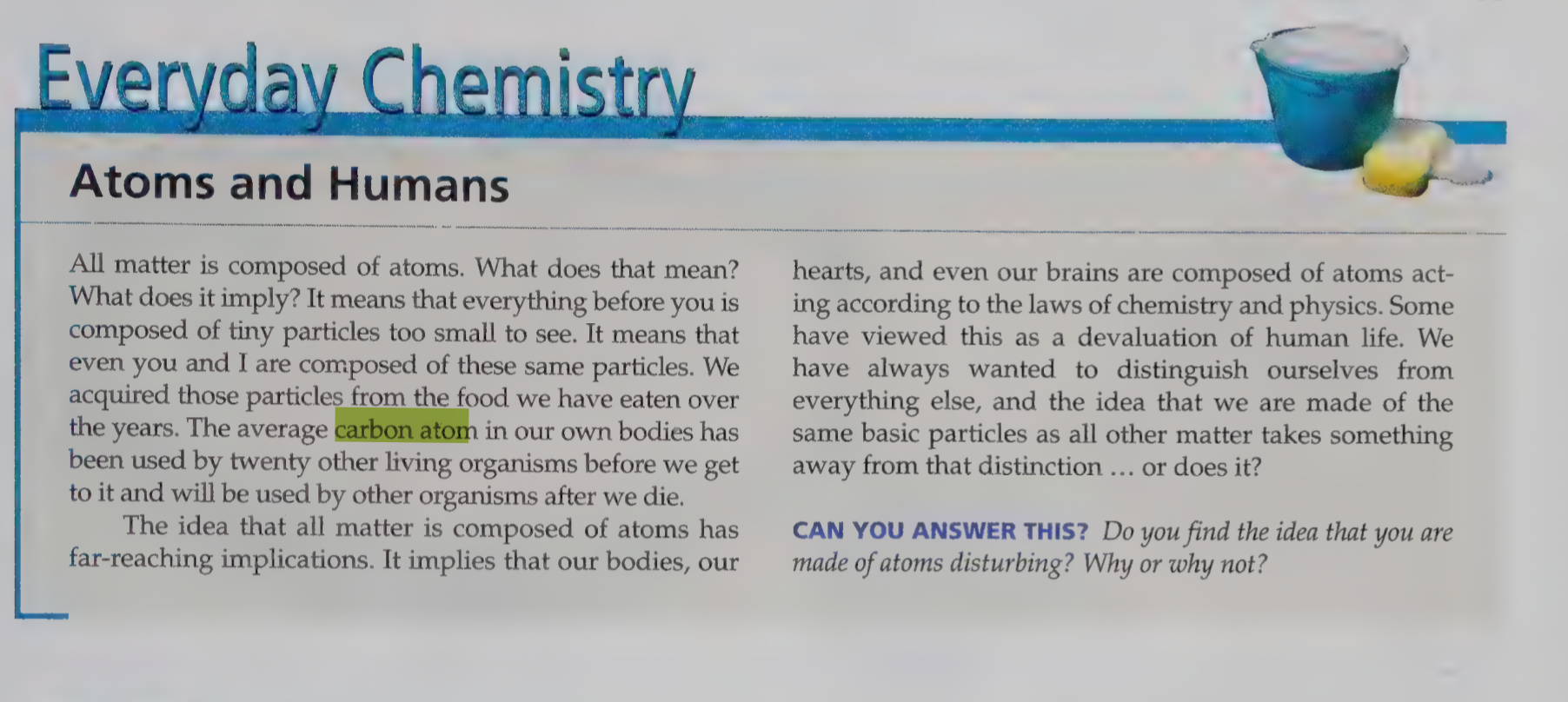
It’s been six years since that class.
What does that mean?
After you die, the carbon atoms that made you might go on to make another living thing.
As you established that is not true, however you can add some of that carbon from some body and add it to the iron from the blood of 400 other human bodies so you can forge one nice sword.
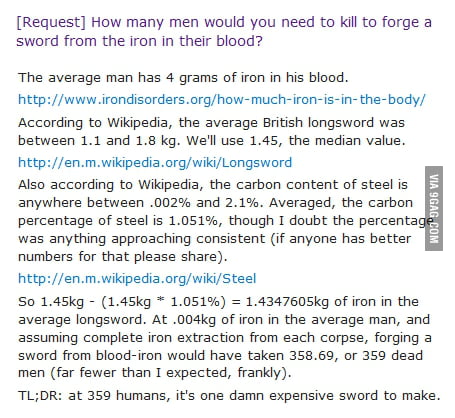
Holy shit lol. This is amazing!!!
that doesn’t make any sense. Carbon doesn’t get less stable by being used in bodies.
Carbon 14 exists, but that decays regardless if it’s in a body or not. At has quite a long half life
At least is a heavy lifting qualifier in this case.
That time passes differently in galaxies with different gravities. One of these galaxies is Mormon heaven.
…wtf?? How do you have negative one downvote?

I saw that recently too. There’s some bug somewhere.
If you downvote it it goes back up to zero and everything.
Wait what
Gravitational time dilation is an effect of Einstein’s General Theory of Relativity. Places with stronger gravity would then have time pass more slowly compared to earth. The opposite is also true.
I think it’s the Mormon bit that’s being questioned.
Kolob is a planet or star where God resides. Time moves very slowly there. Hence the high gravitational field. Probably because God is massive. I don’t know. I’m not a Christian scientist.
Ironically Christian Scientists are actually a distinct sect/cult of US Protestant Christians and would be very angry at the Mormon idea of Kolob if they heard about it.
They also put out a pretty decent newspaper The Christian Science Monitor. At least they did 30 years ago. They don’t take much medicine either, which, fine I guess.
The problem is that they will tell people to pray away cancer, that diseases and injuries and such can be healed spiritually.
That means you can end up with kids who need actual medical help, and won’t get it, and will then be told that they’re sick because they didn’t pray hard enough, that their soul is impure and that’s why they’re sick.
Biological evolution
For the sake of discussion, let’s say on the one hand a magic man intelligently designed life and all that. And on the other hand we have it arise and evolve over the course of billions of years of random atomic interactions and genetic mutations. I honestly find the second one far more amazing, wondrous, amazing, and mind blowing.
@[email protected]
There’s no “magic man” and “magic”. There are a lot of theories of magic with lots of details. If you’d dive deeper into the topic, it would be as mind blowing for you as a theory of evolution. So you just choose a theory which looks more interesting for you.I don’t know but imagine what crazy processes would lead to creating that magic man floating around in nothingness, without a world to evolve on.
A shotgun
…? … Oooooohhh. Haha that’s some fine gallows humor.
OK, it’s really a mathematics equivalence, rather than a scientific fact, but Euler’s Identity:
eiπ + 1 = 0
https://en.wikipedia.org/wiki/Euler's_identity
it shows a profound connection between the most fundamental numbers in mathematics.
There are more hydrogen atoms in a molecule of water than there are stars in the solar system
fuck.
Not just that, it’s twice the amount!
deleted by creator
Something should be done about this
Stop fucking clapping then
Correspondence of lovers: He: darling, without you 60 minutes seem like one hour to me! She: I love you so much, wow he is such a romantic!
🤣 in Solar system only one star… the Sun! Go to school!!!
so it’s right
it was a stupid and meaningless statement… 🤣
🤔 2 hydrogen atoms in one molecule, 1 sun in our solar system 🤔
If math is actually uncovering fundamental laws of the universe, rather than just describing it at various scales, then there’s a chance we can rewrite reality with our own set of rules that would render the current ones incompatible (by Gödel’s-IT).
https://en.wikipedia.org/wiki/Mathematical_universe_hypothesis
Tegmark’s MUH is the hypothesis that our external physical reality is a mathematical structure.[3] That is, the physical universe is not merely described by mathematics, but is mathematics — specifically, a mathematical structure.
Look, I only heard about this concept, so maybe there’s more to it, but branches of mathematics are just a set of rules that we create.
Sometimes these rules can be applied to real systems, in our reality, and that helps to describe and understand the universe.
But it’s totally possible to come up with infinite nonsensical, useless mathematical systems that have nothing to do with the universe. The existence of these doesn’t mean that we have or could rewrite reality.
If our universe is bound by the laws of mathematics (big IF), then any theorem discovered within it has to be consistent or incomplete w.r.t it.
If a theorem is discovered that upends math as we know it, then the repercussions could be cosmic.Again, big if about the universe being bound by the laws of maths
Discovery a truth of the universe is not going to affect the truth of the universe.
You’re appearing to claim something nonsensical. The sort of wow-bang nonsense one reads about in pop-science magazines.
(I’m going to abrasively emphasize the conjunctions more, because I feel they’re being glossed over)
IF the truths of our universe are completely mathematically and axiomatically bound, THEN any proof derived within it might have a chance of upsetting a given axiom given the either incomplete or inconsistent nature of mathematics as declared by Gödel, the ramifications of which COULD be dire in such a universe.
I’m NOT saying our universe IS mathematically bound. I’m also NOT saying that a newly discovered universal axiom WILL change the structure of such a universe.
I actually believe that maths merely describes our reality at varying scales.
I am presenting an interesting idea that for some reason is being taken quite literally, and now am having to get defensive about it as if it’s a deeply-held belief of mine…
Yes, we understood what you were saying.
But your IF is followed by a nonsensical statement.
It’s a precondition that can’t be true.
The fact that planes are kept in the air by the shape of their wings, which forces air to go over at a pace when it can’t push down on the wing as hard as it can push up from underneath. It’s like discovering an exploitable glitch in a videogame and every time I fly I worry that the universe will get patched while I’m at 10,000 feet.
I remember reading a couple years ago that’s not actually how plane wings work. The actual way is much more complicated and hard to explain and hard to teach, so they just teach it this way because its an intuitive mental model that is “close enough” and “seems right”, and it really doesn’t matter unless you’re a plane wing designer.
The basic way an airplane works actually is simple and intuitive: it meets the air at an angle and deflects it downward. The equal and opposite reaction to accelerating that mass of air is an upward force on the wing.
There is, of course a whole lot of finesse on top of that with differences in wing design having huge impacts on the performance and handling of aircraft due to various aerodynamic phenomena which are anything but simple or intuitive. A thin, flat wing will fly though, and balsa wood toy airplanes usually use exactly that.
https://en.wikipedia.org/wiki/Lift_(force)#Simplified_physical_explanations_of_lift_on_an_airfoil
“With a big enough engine you can make a barn door fly.”
The false thing they teach is that air has to go over the longer side faster. Actually, it’s under no obligation to meet back with the same air on the other side, and doesn’t in practice. The real magic bit is the corner on the back, which is not aerodynamic and “forces” air to move parallel to it (eventually, as the starting vortex dissipates).
The pressure difference from different volumetric flow speeds is real, it’s just not that straightforward to produce, because air mostly does whatever it wants. A lot of aerodynamics is still more art than science, and it’s even possible the Navier-Stokes equations it’s based on fail under certain conditions.
deleted by creator
In a sense, everything can fly. Just sometimes not for very long.
deleted by creator
BEHOLD THE CUBE PLANE
You joke, but lemme introduce you to Tacit Blue:

Yes, this thing did actually fly.
Stealth demonstator aircraft from the early 80s.
How do we stop radar? By obliterating the air around us with cube. Lol
That is actually pretty neat though!
Like someone flipped a bathtub over and made it fly.
A Planck length is the smallest length possible, a smaller length simply can’t exist.
At least that’s what scientists believed until they studied OPs penis, then they found out something smaller does in fact exist.

Dude! I told you in confidence not to share that info.
I guess I have no choice but to share that @[email protected] has the world’s biggest human anus. It’s been a scientific mystery about how it got to be so big.
I said out loud at a Warhammer convention that space marines are just dolls for grown men.
I mean… You’re not exactly wrong.
For me, it’s the sheer scale of celestial bodies.
Our Sun is humongous. UY Scuti’s radius is 1700 times larger - 185300 times larger than the Earth’s. And then there’s TON 618, which has a mass 66 billion times larger than our Sun’s.
And even those are barely grains of sand when compared to solar and galactic structures… It is humbling, to say the least.
Edit 2: I deleted the previous edit, because my first observation is correct (scale is maintained when going from comparing radii to comparing diameters…), which is why I have an Arts degree.
Now, think about the energy and forces involved when 2 supermassive black holes orbit each other and collide.
Ooh, those aspects are well beyond my capacity for comprehension or visualisation! I feel like an ant watching nuclear explosions.